Showing posts with label news. Show all posts

Wednesday, 6 June 2012

Detective Work.


Everyone wants to be remembered, and some events will go down in history, never to be forgotten. A quote from our first lecture said that ‘journalism is the first rough draft of history’, and I think it’s true. Through the news, events are recorded and remembered. But in an increasingly fast-paced world, particularly with the birth of online news and the 24 hour news cycle, news seems to be just getting churned out, with little being remembered. Stories get lost in the ocean of news that is presented to us every day, and it seems like journalists just don’t have the time to delve deeper into their stories, because people want information now. But some of the best, most memorable pieces of journalism have been the result of months and years of work, with journalists devoting themselves to digging deeper and finding out the truth. That’s what investigative journalism is all about: getting to the bottom of a story, and finding out the truth.

One of the most important jobs of the media is to hold the powerful to account. Journalism has the ability to reveal massive scandals and wrongdoings, and that’s a big part of what investigative journalism is about. Journalists work as ‘custodians of conscience’, and investigative journalists in particular fall into this category. Investigative journalism is all about exposure, and bringing to light some of the things that are happening in society. The media brings certain issues to the public’s attention, and investigative journalism goes beyond the straight news, and looks for a deeper story. Its news that’s been well researched and well thought out, with journalists investing something of themselves into bringing the truth to light.

You could be forgiven for believing that this kind of journalism is dying, however. With increasing pressure on newsrooms to get the news out fast, journalists have less and less time to probe into the deeper issues that hide behind the surface of a story. And the simple fact that newsrooms are getting smaller and journalists have just got to do more doesn’t help either. Chances are that the six o’clock news won’t have much in the way of investigative journalism, and online news is all about getting the information out first, rather than getting in-depth into an issue. But investigative journalism still does exist. The Global Mail and Australian Story are just two examples of local investigative journalism. The truth is, people still have curiosity, and a desire to find out what’s really going on. And as long as this exists, investigative journalism will survive. And now more than ever investigative journalism stories stand out against the regular news stories churned out by the hundred in newsrooms every day. Investigative journalism has the potential to make history, and to be remembered. So maybe spending a little more time diving into a story is worth it after all.

Sunday, 27 May 2012

The Reality of Reality.


Everyone has a different way of seeing the world. The way we look at reality is shaped by our experiences, our culture, our friends, our family and even our personality. But our perception of reality is also shaped by another thing: the media. The media don’t just report on the world around us; they filter and shape it, making certain issues more or less important. This, in turn, changes the way we look at things, because it changes our focus. This is one of the media’s favourite things: agenda setting.

Agenda setting is all about how the importance the media puts on an issue will impact on the importance society places on it. The simple fact of the matter is that if an issue isn’t in the news, chances are we won’t care about it that much. Agenda setting has two levels. The first is that the media suggests what the public should focus on through coverage. The second is that the media suggests how people should think about an issue. Both can be a little disturbing, when you think about it. The media has the power to tell us what to think about, and sometimes even how to think about it. So are we all just on the way to becoming little media drones, seeing the world exactly the way they want us to see it?

The short answer is no. Agenda setting isn’t all about turning us into Rupert Murdoch robots. Agenda setting feeds off news values, and it needs to exist to some extent, or we’d be being bombarded with endless amounts of news 24/7. People do need to think about the news they hear, however.  You can’t believe everything you see and hear in the media, and people should always stop and ask questions about what they’re being told.

The truth is that to some extent, the media is always going to affect how we see the world. If an issue is big in the news, chances are we’ll be thinking and talking about it. And that isn’t necessarily a bad thing: news can open up our eyes to issues we didn’t know were happening before. But the flip side to this is that there’s a hell of a lot of important issues that aren’t given prominence in the media that deserve to be thought and talked about too. As for the other part of agenda setting, the part about changing the way we think about an issue, that’s where we need to be really careful. Because if we just accept everything we hear, we’re facing becoming little media drones. But thinking is the antidote to letting agenda setting shape our realities without our consent. So start thinking about the way you see the world, and what’s shaping it. And make sure you’re seeing your world the way you want to, not how someone else told you to. 

Thursday, 10 May 2012

What's Your Value?


Values are funny things. When you ask someone what their values are, there tends to be a lot of umming and ahhing while they try to put it into words. Everyone has values, but we rarely stop and think about what they actually are. Values tend to be those intrinsic things that seem to be buried deep down inside of us, things that we just have. But values are relative, cultural things, and we weren’t born with them. Everyone has different values, and this rule doesn’t stop at news outlets. They have values too.

News values, however, vary slightly from the values held by people. Whereas a person’s values tend to be based upon what we see as important in life, news values are all about what makes news newsworthy. Exactly what factors make stories newsworthy is a topic of debate, with people of all different ages and from all different places trying to come up with ‘the list’ of news values. A perfect list, however, is impossible, because news values vary across countries, states, and even news outlets. The news values of ABC and Channel 9 are likely to be different, just as the news values in Australia are likely to be different to the news values in China. So how do we know what makes good news?

Despite all these differences, some news values are pretty universal. The idea of ‘if it bleeds it leads’ and ‘if it’s local it leads’ is seen across the world, with news of disasters, death and tragedy taking priority in the news. Proximity is also a big one. People want to hear about things that are close to home and that affect them, and so stories that are close geographically tend to get more news space too. There are lots of other factors, including currency, uniqueness, simplicity, exclusivity and size, plus a whole host of others that all change depending on where you are and what outlet you work for.

News values, however, aren’t hard and fast rules. Just like the values held by people, journalists often just have a sense for what makes news worthy, and for what their news values are. They don’t often think about it, and I dare say that if you asked a journalist exactly what their news values are there’d be a bit of umming and ahhing as well. But news values are important to understand, even if they are a bit illusive, and nobody can make ‘the list’. Everyone has news values, just like everyone has values.  And maybe it’d be worth doing some umming and ahhing and figuring out exactly what they are. 

Thursday, 22 March 2012

Snap!


Everyone knows that a picture says a thousand words. So it makes sense that in the world of news journalism, a place of short, punchy sentences and word limits, that we'd let pictures do the talking that we don't have the space to do. Sometimes, in fact, pictures have a deeper story than words could ever tell.

Photo albums are a great example of this. Families keep photo albums, or these days, USB’s, full of memories. And these memories are mostly in picture form, with maybe a few words scribbled on the back. People know that pictures tell a story, so when they have a moment they want to remember they take a few happy snaps. You don’t see too many families whipping out their notebooks to take down what’s happening at a family dinner. Instead, Aunty Marg just huddles everyone around for a photo. I, for one, am guilty of sneaking out my Polaroid when a particularly memorable moment arises. So it only makes sense that journalists would start snapping away at the scene of an interesting event.  And since you’d think that journalists would only write about interesting things, there’s a place for a photo in every story.

More and more, photos are starting to tell the story in journalism. Online news websites are littered with photo galleries, and just about every news story published on the web is accompanied by a photo. While some news photos are particularly dull and posed, others stay with you, and convey a much greater meaning than words ever could. Take, for example, this photo taken of the Black Saturday fires. In one picture, so much is said without uttering a single word.


Newspapers, online news and magazines are starting to become the photo albums of the world around us. Sure, words still play a major part. Pictures don’t truly come to life until you hear the story behind them. But it’s important to think about the photos that get put with a story. Just like no one wants to see half of Uncle Albert cut off in a photo, readers don’t want to see some cookie cutter picture that has no life or story behind it. Journalists are getting creative with their photography, and through it are creating some of the best photo albums of history that the world’s ever seen. So snap away, my journalistically minded friends. Because a picture can bring your writing to life, and maybe even give you those magical extra thousand words. 


Tuesday, 13 March 2012

You Catch My Eye.


I like pretty things. That fact is pretty universal. People rely so much on their eyes to judge whether or not they’ll like something, or someone. We pick our clothes, our homes, our things, and sometimes even our friends by what things look like. So why wouldn’t we do the same thing when we’re reading news stories? Don’t stories get to be pretty too?

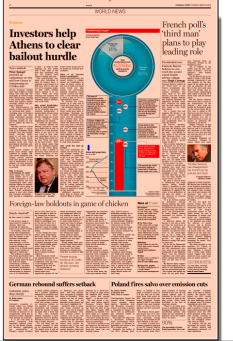
I learnt today in my lecture, taught by guest speaker Skye Doherty, that yes, they do. There’s much more to a story than just the body. The headline, images, captions and quotes are all just as important as the actual story you’re trying to tell. These are what catches the reader’s eye, and sparks their interest. In traditional newspapers, the main story would be on the upper left, often accompanied by a picture or graph, like this:
Slide Five


This is because our eyes scan from left to write. Nifty, hey? But with the development of online media, the way news stories are presented has had to change. No longer do five stories have to be crammed onto a page; the limitless expanses of the web have enabled writers to spread things out a little, and has given them the opportunity to add more than just words and pictures. Hyperlinks, videos and shortcuts to other stories can all now be included. Pretty-ifying has starting to happen to news stories. This expansion, however, has meant that the layout of stories has had to change. Now, more often than not, the look of a story changes depending on where you see it. It’s kind of like an online chameleon. The same story can have different headlines and pictures, depending on where it is on the website. This is all done to catch the reader’s eye, and to make the story more visually appealing.

This is pretty exciting for me.  While online layouts still have some kind of structure, there’s much more freedom as to how your story can look, and exactly what you can put on the page. Not being a tech genius myself, putting said things on a page might be a slight road bump, but having the possibilities there is exciting. Like I said, I like pretty things, and making things pretty is something I love to do.