Thursday, 26 April 2012

Factual Storytelling Exercise: Fairy Tales


Life rarely ever follows fairy tales. People read nice stories all the time, but the inevitable thought of ‘that’ll never happen to me’ always creeps in. From a young age we lose the ability to believe in dreams, and we are told to focus on reality instead. But sometimes putting a little faith in the improbable, and doing something to give your dreams a little bit of a kick start, turns out alright. Sometimes it does people good to follow the advice of a story.

It all started with a book she read. It was about a women who’d had met her husband at the supermarket, they’d started talking, she’d got his number and they’d been happy together ever since. Ann-Marie, however, was newly divorced and shy, and didn’t think that anything like that would ever happen to her. She thought those inevitable thoughts of ‘that’ll never happen to me’ and carried on with her life. Something about that story must have stuck with her though, because a couple of weeks later it sparked her to do something that she never would have thought she’d do.

She was wandering through the aisles of Aldi one day, just doing her shopping, when she saw a man she’d been friends with years ago. Years later, now both divorced, they saw each other there, had a quick chat, and parted ways, just like you would with any other old acquaintance. For some reason, however, Ann-Marie couldn’t get that story out of her head.  She went home thinking about it, about Ed her old friend, and about her. A few days passed, but the thought was still there. So taking a big dose of courage and the advice of a story, she decided to get his number.

Now, the chances of her running into him again at Aldi were pretty slim. So Ann-Marie decided to do something a bit more cunning: she looked up his name in the electoral role. There were only two E. Cavanough’s in there, but she wasn’t brave enough to dial the numbers just yet. So she hopped in her car and drove past the two houses, trying to decide which one was his. By the time she got back home she had a pretty good idea of which one belonged to Ed, but she still wasn’t sure. It seemed so silly, and so improbable, that anything would come out of it. That night she talked to her daughter about it, sounding like a giggling schoolgirl when she asked “Do you remember Ed?” She told her daughter about what had happened, and what she’d done. Her daughter, while shocked that her sweet, shy little mother would do anything like that, told her to go for it. “What’s the worst that could happen, mum?” she asked. Ann-Marie chose not to answer that question with the rising amount of fear and doubts filling her head, and instead decided to sleep on it and do something in the morning.

The next day she somehow found herself sitting in front of the phone, dialling the number of a certain E. Cavanough. “If this isn’t him”, she told herself, “I’ll give up and forget about the whole thing.” Heart beating fast, she pressed dial and waited. Eventually a somewhat familiar voice answered with a “hello?” and everything froze. She asked if this was Ed, and did he remember her. They’d met in Aldi the other day, yes? How was he? They talked for a little while, and then Ann-Marie did something she never would’ve thought she’d do: she asked him on a date.

Shocked by everything she’d had the courage to do, Ann-Marie met Ed the met the next day for coffee. They talked some more, and it turned out that even after all the years between seeing each other they still had a lot in common,  and liked being around each other. Ann-Marie told Ed about the story she’d read, and how it had inspired her to track him down. They decided to meet up again, and after a few weeks they were going out.

A year later they got married, and pretty much lived happily ever after. All of this was because she had decided to believe in something slightly ridiculous, and put some faith in what was a little bit of a fairy tale. Instead of sticking to the belief that ‘nothing like that will ever happen to me’, Ann-Maire made something improbable happen, and it paid off. So maybe there is some truth in fairy tales, and good things don’t just happen in books. Sometimes spicing up reality with a little sprinkling hope in the improbable turns out for good. 

A Thousand Shades of Grey.


We don’t live in a world of black and white. We live in a world made up of a thousand different colours and shades. We live in a world where lines blur, and the difference between right and wrong isn’t always as clear cut as it should be. Sometimes knowing what’s right isn’t as straightforward as picking between two options. The reality is that sometimes there are a million different shades of right and wrong to choose between, and the line isn’t always that easy to see.

Ethics play a big part in our lives, and they’re also crucial to the world of journalism. Journalism’s a profession that, thanks at least in part to a certain Mr Murdoch, often receives a lot of flak for being unethical, and for going about things and getting information in the wrong way. In our lecture this week, however, we learnt that journalists can actually be an ethical bunch, and that’s definitely the kind of journalist I want to be.

Being ethical, however, isn’t as easy as it sounds. Ethics is often about choosing between a bad and a very bad outcome, and different people see different outcomes as more or less ethical. Ethics isn’t black and white, and there are many different approaches. Some believe in deontology, which says that you do the right thing by following the rules. But what about when the rules are wrong? It used to be a rule that black people couldn’t even drink from the same water fountains as white people, let alone go to the same school or earn the same wages. That rule isn’t ethical at all. Following the book doesn’t necessarily make you ethical, as some rules need to be broken.

Others believe in consequentialism, where the ends justify the means. This can be a very dangerous guideline though, as some horrific things have been done throughout history in order to achieve some end. Sometimes the price really does outweigh the reward you get, and often that reward only benefits a certain group of people. And there isn’t anything ethical about making others suffer for the sake of the betterment of a single group.

The last form of ethics theory is virtue. This bases itself on intrinsic values, and the belief that we all have the potential to have good character traits inside of us, and that these will guide us through life. This is a wonderful thing to believe in, but the truth is that some people just don’t listen to that little voice inside their heads. So we can’t really rely on people’s good character to make ethical decisions all the time either.

How do you make an ethical choice then, when no one way of going about it is always correct? Companies make ethics guides, philosophers and thinkers debate about it, but no one has the answer. So perhaps all we can do is trust our instincts, and pick the choice that lies behind one of those thousands of shades of options. No, you won’t always pick the prefect shade. People mess up all the time. But by thinking about other people, and about how our actions will have an impact on them, we might just get a little closer to that golden ethical colour. 

Thursday, 19 April 2012

Curiosity and Cats.


Curiosity is a marvellous thing. People find out about the most interesting things and places just by being a little curious. Being a little inquisitive makes life interesting, and people love finding out new things. Curiosity may have killed the cat, but satisfaction brought it back. If people weren’t a little curious, the world would never get anywhere.

In the world of journalism, public media is kind of like that. The ABC is famous for its news analysis and current affairs programs, and public media stations are often seen as the place to go for some good, in-depth analysis. In contrast to commercial media’s tendency to be about shocks and thrills, public media tends to be a bit more serious and factual. Public media is kind of like the textbook of the news world, whereas commercial media is the magazine.  The news is a bit more about facts, and a bit less about fun.

The problem comes, however, when this just isn’t the kind of thing people want to watch. Because the truth is, very few people would read a textbook over a magazine. Public media might be deeper, but commercial media looks like more fun. Sometimes people just want light and fluffy, easy to digest things.
So why does public media stick around? Who but old, boring people watch it? In today’s fast paced world, people don’t seem to have time to sit down and really dive into issues. But public media offers something that commercial media, generally, doesn’t. Investigative journalism, the kind that dives right in and makes people think, is everywhere on the ABC. Robert Richter said that public media is the “last bastion of long-form investigative journalism”, and I think it’s true. Public media doesn’t have to think about its shareholders, or making a profit. It has to think about following people's curiosity, and making really good news.

This, I think, is a big part of why public media sticks around. Because people are curious, and they want to go deeper into the bigger issues. Sure, public media isn’t prefect. It’s got a lot of problems to face, and keeping up with the popularity of commercial media is no small challenge. But public media offers something that no one else does, and in order for the world to keep working properly, its needs to stay.

Friday, 6 April 2012

Money Money Money.


Money makes the world go round. Underneath so many things lies the world’s most sort-after substance: money. Media is no exception to this rule. Commercial media rules the media production world, with public media taking up only a very small portion. I say media, you say Rupert Murdoch. The news isn’t just about facts; it’s about profit too.

Commercial media makes its money off just that: commercials. It sells ‘eyes and ears’ to advertisers, and the more popular the show, the more expensive the ad spaces will be. This all sounds just dandy in theory, but in practice, it’s not quite as nice. In order for shows to be popular and to get more viewers, commercial media can be tempted to sensationalise news, and make it more about entertainment and less about facts. Because the fact of the matter is that shocking things sell, and at the end of the day, commercial media is just another business. If it stops making money, it disappears.

But what does this mean for news? Is the news going to have to get dumber and dumber, just so that it can keep going and make a profit? With the rise of web 3.0 advertisers are able to reach much more specific demographics, and companies are beginning to invest in other things than television commercials. Commercial media is having to work harder than ever to make a living. And when the desire to please overtakes the responsibilities of the media in a democracy, things start getting scary. 

So what’s poor old commercial media going to do? As we were asked in our lecture today, can it really deliver on both commercial and social functions? Or does one get sacrificed at the expense of another? And what are we journalists meant to do? Should we continue to write good news and face the possibility of one day living on the streets, or do we sell our souls, and pens, to the mighty dollar? Is the internet the saviour of journalism? Nobody knows all the answers, and it’s a scary world out there, but it’s also exciting. Media is changing, and it’s at a pivotal point in its history. Money may make the world go round, but it’s journalists that tell us about it, which makes me think that they’re here to stay. 

Thursday, 29 March 2012

Captain of My Planet.


To some extent, we all live in our own little worlds. Granted, some of us are more off-with-the-fairies than others, and I’ll be the first to admit that I don’t always have both feet on the ground. But our little worlds, the way we see things, shape our worldview, and the way we see others. All too often though we get comfortable there, because things are nice and familiar and normal and right. We hold on tight to our little slice of reality, and bite back fiercely at anyone who dares to question or try and change it. Slowly though, and I think a little scarily, we can become close-minded. Our little worlds stop growing, and our worldviews stay set.

In my lecture this week, which took place in the comfort of my own bed, I listened to Richard Fidler and Steve Austin talk about radio. Each of them talked about their experiences as radio hosts, and about the kinds of things you need to do on radio. But something that struck me was the idea that radio, through conversation, allows us to see into other people’s lives, and into their little worlds. Listening to other people’s stories tells us so much about the world around us, and can open our eyes to different ways of seeing things. But sometimes we close our ears to other people, because we don’t like what they’re saying, or we don’t agree with them.

Radio is one of the oldest media forms, and you’d think it might be on a decline by now. And granted, people don’t tend to huddle around the radio any more to get their nightly news. But people still listen to the radio, whether they’re in the car on the way to work, doing something at home or most recently, through podcasts. Steve Austen said that sometimes you just have to “talk less, and listen more” and  radio allows us to do that. We get to sit back and listen to what others have to say, get a little slice of their world, and compare it with our own.

Richard Fidler said something very interesting. He said to “be open-minded. Expose yourself... to thoughts and ideas you don’t agree with…try and expand your worldview as much as possible.” I think this is a challenge worth trying. Listen to the radio, dive into a book, and ask questions. Try and see inside other people’s little worlds, and expand yours. Because when it comes to worldviews, the bigger the better. Don’t get me wrong: you don’t have to agree with everyone. Just try and see the world from a different point of view. I think that’s what really good story telling and journalism does: it allows people to see the world in a way they hadn’t before.  When this happens, our little worlds keep growing, and we can stop ourselves from becoming close-minded and stubborn. So take a step inside the world of someone different to you, and have a look around. You might like what you see. 

Media Use Diary


Journalism and communication has started to see a shift from the use of old media, namely newspapers, magazines, radio and television, to new media, which revolves around the internet. As such, media platforms have had to change from traditional forms to online ones. The rise of new media usage is the topic of this dossier.

I logged my media usage for ten days (figure 1.0), and then compared it to the results of the survey.
Figure 1.0

The majority of media used was online, with online news and Facebook having the highest total time. Blogging, magazines and television were also used a lot, though their time was nearly half of that seen for Facebook.

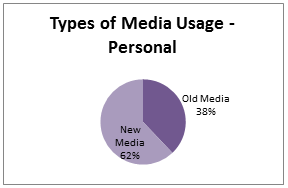
This preference for new media was not seen in the survey results however. In the survey, more old media was used than new media (figure 2.0). This conflicts in comparison to my media usage (figure 3.0), where it can be seen that new media was used more.

Figure 2.0
Figure 3.0

While these results indicate that I use a much higher amount of new media than average, the time I spent online each day was significantly less than that seen in the survey. I spent approximately 45 minutes online each day, whereas the average was 1-3 hours. Also, television was the main way people got their news, whereas my main form of news was online newspapers.

These differences could be attributed to the fact that online platforms are easier for me to access than other media forms. Online news made up the biggest percentage of my media use, followed by Facebook, another easily accessed form. These results do have some similarities with the survey results however, as the second biggest source of news was online newspapers, and 91.1% of the time people spent online was on Facebook. My media usage, therefore, does have some similarities with the survey.

Figure 4.0
Usage versus producage was created with web 2.0. Produsage can be defined as:
“…the collaborative, iterative, and user-led production of content by participants in a hybrid user-producer, or produser role.” (Bruns, 2005).
Approximately 22% of my interaction with media was producage, as can be seen in figure 4.0. This included Facebook posts, tweets, and blogging. In regards to the survey results, while it is hard to determine exactly when people use and produce media, the fact that 97.2% of individuals have one or more Facebook accounts, 32.3% use Twitter and 41.4% have blogs indicates produsage. These statistics show that produsage is becoming a big part of media, and therefore journalism, with individuals being able to participate in media production.

These trends indicate that the way people use media is changing, with new media forms and produsers affecting media consumption and production. In regards to my media usage, it can be seen that my relationship with journalism is mostly in new media, and that I not only use but also produse. This indicates that generally, media is starting to encompass new forms, and that people are engaging with them in new ways. 


References
Bruns, A. (2005). Towards Produsage: Futures for User-Led Content Production. [available online] http://snurb.info/files/12132812018_towards_produsage_0.pdf last accessed: 29/03/12


Sunday, 25 March 2012

Just Butter, Thanks.


I saw this ace little video while I was procrastinating about writing my media diary dossier, and thought I might blog about it. See, procrastination does have its benefits!

I really liked this video, because it shows the power of boring words, the kinds of words you and I use all the time. Some of the most powerful, memorable statements were just a simple, neat collection of bread and butter words.

The fact of the matter is that people need to be able to connect with what’s being said and written. “No coordinates exist like one’s domicile” really doesn’t hit home for me. It took me a minute to figure out what the hell that phrase even meant. The truth is, people hold word snobs in much too high esteem. Knowing the meaning of the word ‘tellurian’ doesn’t make you a literary god. Writing a good, powerful, simple sentence does. I must confess that I’m guilty of dropping an oversized word in now and then, and I may have possibly subscribed to dictionary.com’s ‘Word of the Day’ for just that purpose. Big words to have a place and a purpose, don't get me wrong. But this lovely little video has given me the epiphany that big words aren’t always better. So from now on, I might just start appreciating the bread and butter of the language world, without always adding the jam.